

 русский
 Español
 عربى



Heavy Duty Truck S-Cam Brake Chamber: Sizes, Types and Selection Guide
Content
- 1 What an S-Cam Brake Chamber Actually Does
- 2 Service, DD, and DP Chambers: What the Labels Mean
- 3 Type Number and Stroke: The Two Numbers That Matter Most
- 4 Ports, Fittings, and Mounting: Where Interchange Gets Tricky
- 5 How to Confirm the Chamber Is the Problem
- 6 What Makes a Heavy-Duty Chamber Reliable
- 7 What to Verify Before You Buy
A truck pulls into the shop with the low-air warning light flickering at the end of a delivery route. The technician traces the leak to the right drive axle: the S-cam brake chamber hisses through the clamp band the moment the service brakes are applied. The push rod stroke measures past the 2-inch adjustment limit, and the diaphragm has cracked along its fold line. The fault is easy to find, but the replacement decision is where mistakes happen.
A heavy-duty S-cam brake chamber is specified by more than a part number. The chamber family, effective area, stroke, port style, and mounting configuration all have to match the axle. Choose the wrong combination and the truck is back in the bay within weeks, often with a rejected brake inspection or a roadside failure. This guide explains what the markings mean, what to check before ordering, and how to select a chamber that will still be performing years later.
What an S-Cam Brake Chamber Actually Does
An S-cam brake chamber converts compressed air into the mechanical force that stops a heavy truck. When the driver applies the brake, air from the reservoir enters the pressure port and pushes against a rubber diaphragm. The diaphragm moves a push rod outward, the push rod rotates the slack adjuster, and the slack adjuster turns the S-cam. The curved cam profile spreads the two brake shoes against the drum, generating friction at the wheel.
The chamber rating determines how much force the foundation brake can produce, because force equals air pressure multiplied by diaphragm area. At 100 psi, a Type 30 chamber with 30 square inches of effective diaphragm area delivers roughly 3,000 pounds of push rod force; a Type 36 delivers about 3,600 pounds. That is why matching the size matters: an undersized chamber cannot provide the clamp force the axle was designed for.
The operating sequence in brief:
- Compressed air enters the chamber port.
- The diaphragm deflects and extends the push rod.
- The push rod rotates the slack adjuster and S-cam shaft.
- The S-cam pushes the shoes outward against the drum.
Service, DD, and DP Chambers: What the Labels Mean
Commercial vehicles use three main chamber families, and the label stamped on the housing tells you which job the chamber does.
- Single (service) brake chamber — provides service braking only. It is standard on steer axles and on trailer positions where the parking brake is handled elsewhere.
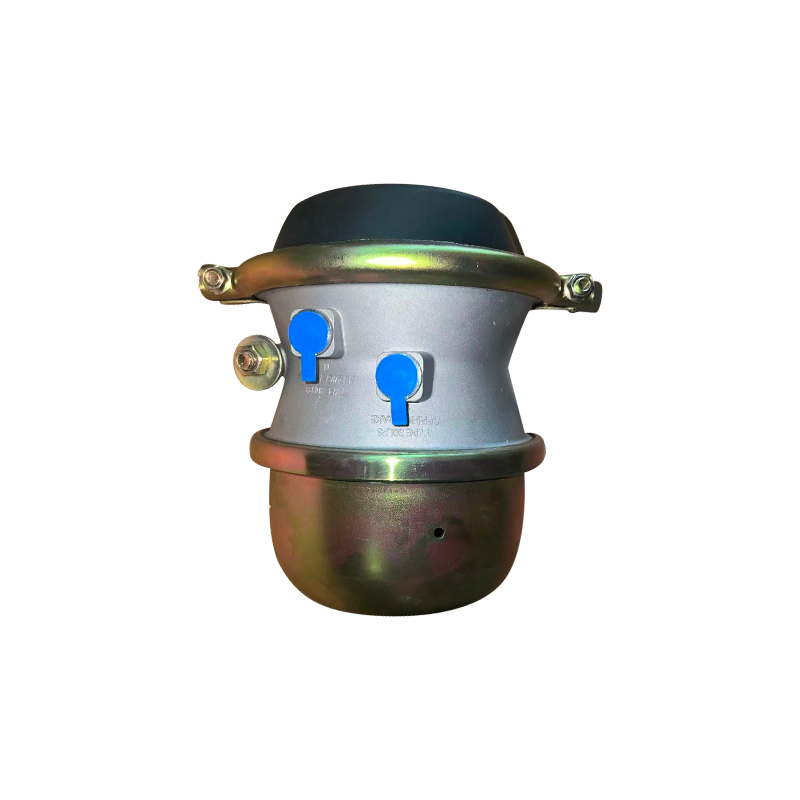
- DD (double-diaphragm) spring brake chamber — combines a service chamber with a spring-applied parking and emergency brake. When air pressure drops below the spring force, the power spring applies the brake mechanically. DD chambers are the usual choice for drive axles.
- DP spring brake chamber — a variant in which the parking-brake section uses a piston-type arrangement instead of a second diaphragm. DP chambers are common on heavy-duty axles built around European port systems, including Voss-type fittings.
| Chamber family | Service brake | Parking/emergency brake | Typical position |
|---|---|---|---|
| Single (service) | Yes | No, handled elsewhere | Steer axles, some trailer positions |
| DD (double diaphragm) | Yes | Yes, spring applied and air released | Drive axles of trucks and tractors |
| DP (piston-type spring) | Yes | Yes, spring applied and air released | Heavy-duty axles with European port systems |
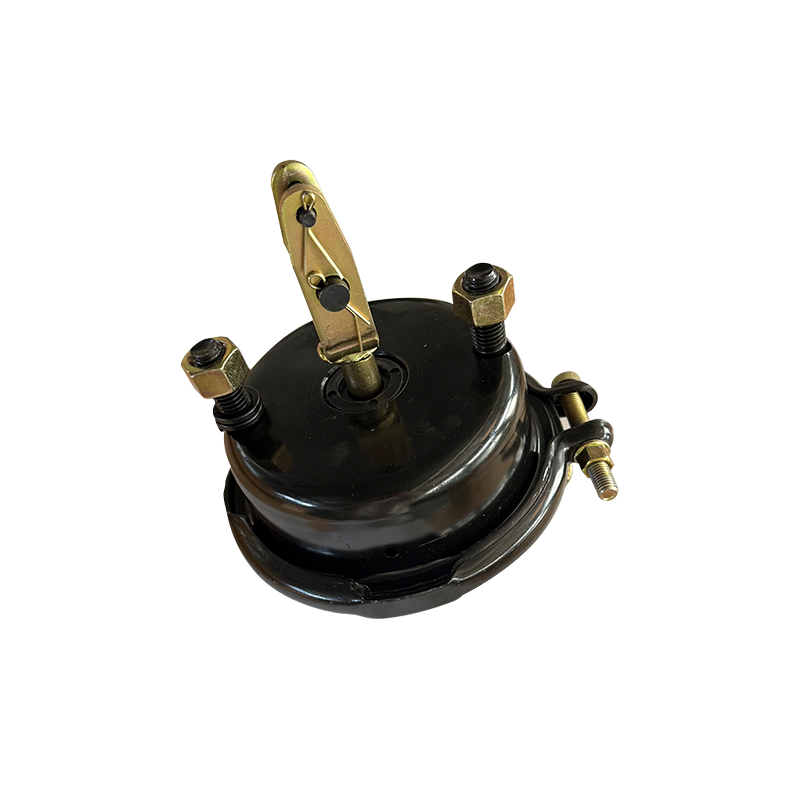
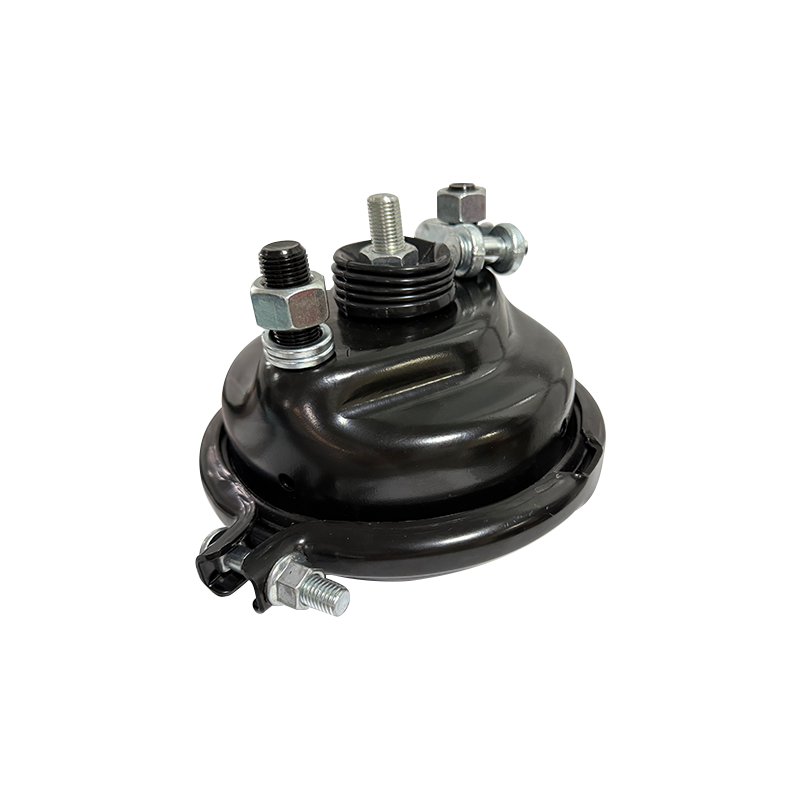
For heavy-duty trucks and trailers, the most frequently ordered replacement is a Type 30 DD chamber. The T2430 long-rod black brake chamber is built in this family: a Type 30 DD design with a long rod for direct connection to the slack adjuster, which simplifies installation on standard S-cam axles.
 T2430 Long-Rod Black Brake Chamber for Type 30 DDThis Type 30 DD brake chamber features a long rod for direct slack adjuster connection on S-cam axles. It offers a dual-clamp design, trimmable rod length, and a thickened oil-resistant diaphragm for durable heavy-duty braking.View Product →
Type Number and Stroke: The Two Numbers That Matter Most
The type number stamped on the housing is the effective diaphragm area in square inches. Types 16, 20, 24, 30, and 36 cover nearly every heavy commercial vehicle on the road. The chart below shows the approximate push rod force each type can generate at a typical 100 psi operating pressure.
| Type | Effective diaphragm area | Typical application |
|---|---|---|
| Type 16 | 16 sq in | Light commercial vehicles and buses |
| Type 20 | 20 sq in | Medium-duty trucks and trailer positions |
| Type 24 | 24 sq in | Medium-heavy axles and European trailers |
| Type 30 | 30 sq in | Standard Class 8 drive and steer axles |
| Type 36 | 36 sq in | Severe-duty and high-output axle positions |
The second specification is stroke: the distance the push rod can travel. Standard-stroke chambers suit new or lightly worn linings. Long-stroke chambers add usable travel without changing the diaphragm area, so the push rod stays within its efficient range as linings wear and the slack adjuster takes up more slack. A Type 30 chamber, for example, is available with a 2 1/2-inch standard stroke and a 3-inch long-stroke version. If your operation runs through demanding grades or high-mileage routes, long-stroke versions are worth the small additional cost.
Ports, Fittings, and Mounting: Where Interchange Gets Tricky
The port is the most common interchange trap. A chamber that fits physically can still fail to accept the air line fitting. North American air systems frequently use NPT-threaded ports, while European-designed brake systems commonly use metric and Voss-type connections. Before ordering, confirm the thread size on the truck's air line: 1/4-inch NPT, 3/8-inch NPT, M22, and M18 adapter ports all appear on current heavy-duty models.
Mounting hardware follows the same logic. Some chambers are supplied with a long rod and clevis for direct connection to the slack adjuster; others use a welded clevis or a stud-type flange. The T24 2.5 single brake chamber, for instance, is a Type 24 unit with an M18 hole, suited to installations that route the air supply through a banjo or adaptor fitting. Check the old chamber's rod length, clevis pin size, and port before placing an order.
How to Confirm the Chamber Is the Problem
Brake chambers do not fail without warning. The signs are specific, and these checks will tell you whether the chamber itself is at fault:
- Air leak — spray soapy water around the clamp band, the port, and the breather. Bubbles that appear when the brakes are applied point to a leaking diaphragm.
- Excessive stroke — if the push rod stroke stays past the 2-inch adjustment limit even after the slack adjuster is reset, the chamber has lost its reserve travel.
- Hissing at the breather — air escaping from the breather on release indicates a damaged service diaphragm; air escaping while parked indicates a leaking spring chamber.
- Housing damage — cracks, heavy corrosion, or a deformed clamp band mean the chamber must be replaced.
- Erratic release — a push rod that sticks or returns slowly signals a broken return spring or contamination inside the chamber.
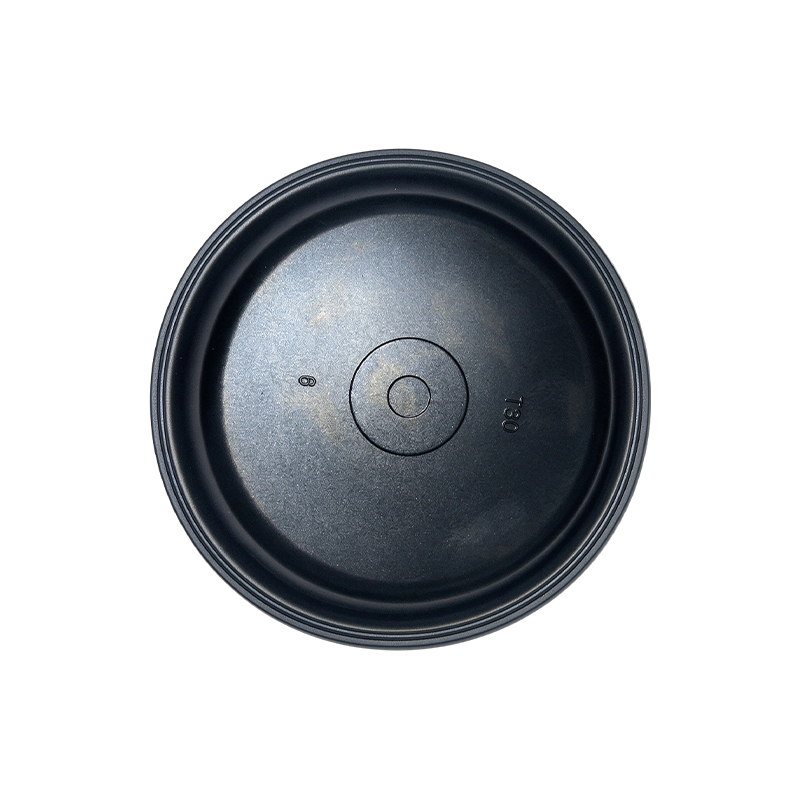
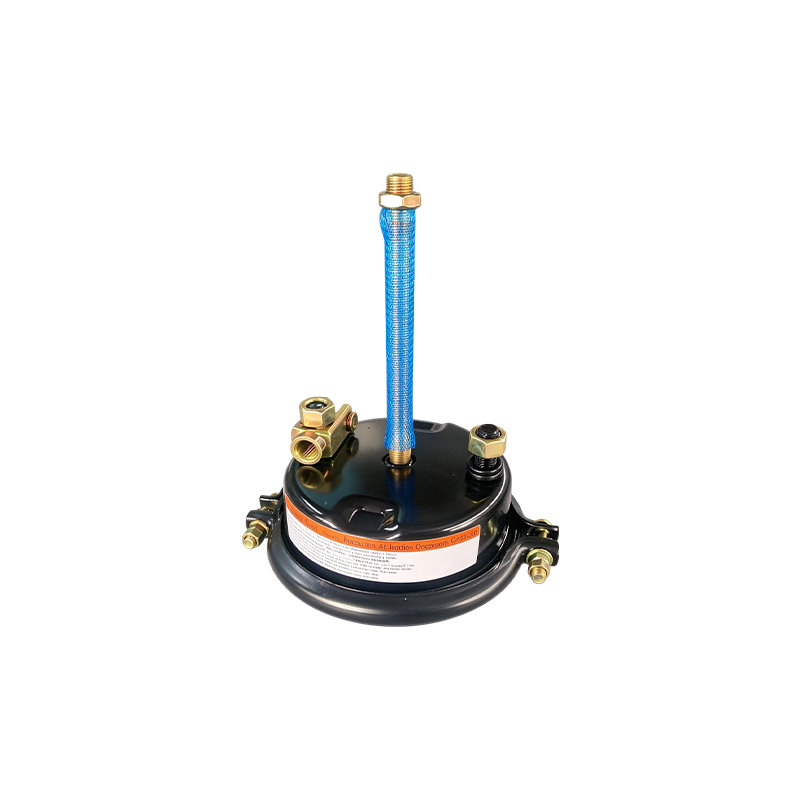
If the housing is sound and the failure is limited to the diaphragm and seals, a repair kit is often the most economical route. The DD brake chamber repair kit replaces the diaphragm, power spring, and sealing components so the original unit can return to service without replacing the entire housing.
 DD Brake Chamber Repair Kit for Diaphragm and Spring ReplacementThis repair kit restores dual-diaphragm brake chambers by replacing the diaphragm, power spring, and seals. It reduces maintenance costs and downtime while ensuring precise fit and reliable braking performance after installation.View Product →
What Makes a Heavy-Duty Chamber Reliable
A brake chamber has few moving parts, but it works in a punishing environment: heat radiating from the drum, road salt, water spray, and continuous flexing of the diaphragm. Reliability comes from materials and manufacturing discipline. The diaphragm compound must stay flexible at low temperatures and resist ozone and heat cracking. Sealing between the service section and the spring section determines whether the chamber develops air leaks after thousands of cycles. The housing and surface finish decide how long the unit survives road salt and stone impact. A manufacturer that tests at low and high temperatures, checks sealing performance over repeated cycles, and inspects every unit before shipment can document the margins that cheap parts hide.
That is why professional buyers look at the factory as much as the price. Rongzhan operates its own aluminum die-casting and stamping shops, so the housing, mounting parts, and surface treatment are controlled in-house from raw material to finished piece. The company runs a 100% pre-shipment inspection and publishes technical articles on sealing performance under temperature changes that are worth reading before you set a specification.
What to Verify Before You Buy
For a fleet manager, distributor, or OEM buyer, the final checklist looks like this:
- Markings — the housing stamp shows the type and stroke. Do not accept unmarked chambers for safety-critical stock.
- Port and thread — compare with the air line fitting on the truck.
- Mounting — long rod, welded clevis, or flange; measure the clevis pin hole if possible.
- Documentation — ask for dimensional drawings and test reports at cold and hot conditions.
- Material options — zinc or coated finishes for road-salt regions, specific rubber compounds for extreme climates.
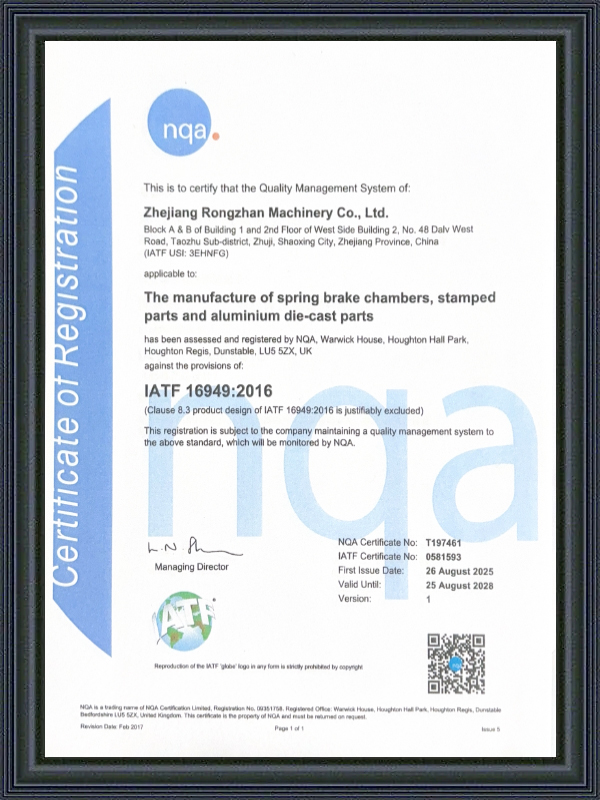
A supplier that controls its own casting and stamping, and that publishes its manufacturing background and certification, is easier to qualify than a trader that cannot show where the parts are made. That transparency matters even more when you are ordering brake parts for trucks that run cross-border routes with varying inspection standards.
The S-cam brake chamber looks like a simple can with a rod, but every detail — the diaphragm area, the stroke, the port, the mounting — determines whether the brake performs as designed. Match all of them, verify the supplier, and the chamber will do its job for hundreds of thousands of miles.



-
A fleet running 40-ton tractors can feel the difference between two nominally identical S-cam brake...
-
A Sourcing Scenario Every Fleet and OEM Buyer Should Recognize A fleet maintenance supervisor appro...
-
The modern commercial transport industry relies heavily on air brake systems to ensure fleet safety...
-
Direct Conclusion: Selecting the correct heavy duty brake chamber requires evaluating your commer...
-
Piggyback Brake Chamber: What It Does and Why Specs Matter When a trailer sits overnight and you he...
-
A heavy duty brake chamber that fails at 200,000 miles instead of 600,000 miles is rarely a design ...

- WHY US
- Company Profile
- Certifications
- News
- PRODUCTS
- S-Cam Type Brake Chamber
- DISC Brake Chamber
- Wedge Brake Chamber
- Piggyback Brake Chamber
- Brake Chamber Repair Kits
- MANUFACTURING
- Customer Service
- Factory Tour
-
-
No.90 Zhancheng Avenue, Zhuji City, Zhejiang Province, China

-
rongzhan@zjrongzhan.com / judith@zjrongzhan.com

-
+86-15258814607

-
- CONTACT


