

 русский
  Español
  عربى
عربى 


Driving Efficiency: An Engineering Comparison of Heavy Duty Truck S-Cam Type Brake Chambers
Content
- 1 Understanding the S-Cam Type Brake Chamber Architecture
- 2 Standard vs. Long-Stroke: A Comparative Engineering Analysis
- 3 Operational Impact on Fleet TCO and Fleet Safety
- 4 Mechanical Failure Modes and Preventative Diagnostics
- 5 Procurement Considerations for High-Value Commercial Fleets
- 6 Frequently Asked Questions (FAQ)
- 6.1 How do I identify if my vehicle is equipped with standard or long-stroke S-cam type brake chambers?
- 6.2 Can I mix standard and long-stroke S-cam type brake chambers on the same axle?
- 6.3 What causes an S-cam type brake chamber to drag, and how does it impact fuel economy?
- 6.4 What is the ideal pushrod angle for a heavy duty truck S-cam type brake chamber during application?
- 6.5 How frequently should the diaphragms inside an S-cam brake chamber be inspected?
The modern commercial transport industry relies heavily on air brake systems to ensure fleet safety, regulatory compliance, and operational efficiency. At the heart of this stopping power lies the S-Cam Type Brake Chamber, a critical component that converts compressed air energy into the mechanical force required to stop a fully loaded commercial vehicle. Selecting the correct chamber configuration directly impacts a fleet's bottom line by minimizing maintenance downtime and preventing catastrophic brake fade.
The Bottom Line
For modern fleet operations, upgrading to long-stroke heavy duty truck S-cam type brake chambers provides a critical safety margin. By offering an extended pushrod travel limit, long-stroke chambers drastically reduce the risk of brake misalignment and fade under extreme operating temperatures, making them the superior financial and operational choice over standard-stroke alternatives.
Understanding the S-Cam Type Brake Chamber Architecture
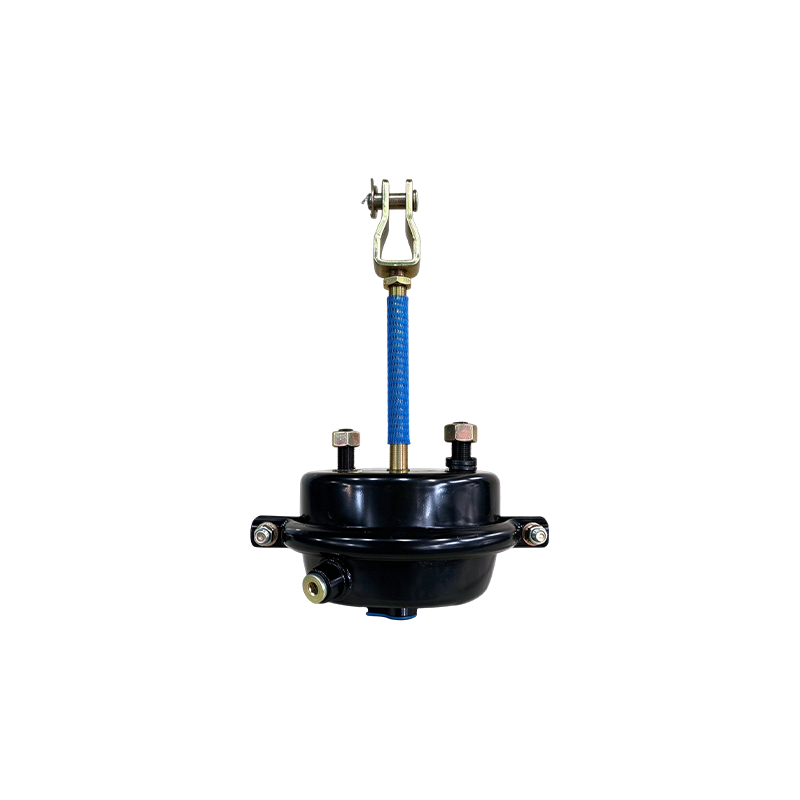
To optimize braking efficiency, fleet managers must understand the internal dynamics of the heavy duty truck S-cam type brake chamber. When the driver presses the brake pedal, compressed air enters the pressure chamber, forcing a flexible diaphragm forward. This diaphragm moves the pushrod, which rotates the slack adjuster. The slack adjuster then turns the S-cam shaft, forcing the brake shoes outward against the drum.
Any loss in force transmission within this sequence compromises stopping distance. For instance, a standard Type 30 chamber operating at 100 PSI generates approximately 3,000 pounds of linear force. However, if the pushrod travel exceeds its mechanical limits due to heat expansion or wear, the force dropped can compromise vehicle control.
Standard vs. Long-Stroke: A Comparative Engineering Analysis
The primary differentiation in modern heavy-duty applications lies between standard-stroke and long-stroke configurations. As thermal loads increase during heavy mountain descents or stop-and-go urban transport, brake drums expand radially. This expansion requires the pushrod to travel further to maintain contact between the brake shoe lining and the drum.
| Specification / Feature | Standard S-Cam Type Brake Chamber | Long-Stroke S-Cam Type Brake Chamber |
|---|---|---|
| Typical Rated Stroke | 2.50 inches (64 mm) | 3.00 inches (76 mm) |
| Re-adjust Limit (CVSA) | 2.00 inches (51 mm) | 2.50 inches (64 mm) |
| Thermal Expansion Tolerance | Moderate; prone to premature fade under high heat | High; accommodates significant drum expansion |
| Risk of Mechanical Over-stroke | Higher under severe duty cycles | Significantly reduced due to extra 0.5-inch reserve |
| Identification Markers | Standard square port bosses | Trapezoidal or embossed port markings, cut-out tags |
Operational Impact on Fleet TCO and Fleet Safety
High-value fleet operators evaluate components based on Total Cost of Ownership (TCO) and risk mitigation. Integrating an advanced S-cam type brake chamber into commercial fleets yields measurable improvements across several core key performance indicators:
- Reduced CVSA Out-of-Service Violations: Brake-related infractions account for nearly half of all vehicle out-of-service (OOS) violations during Commercial Vehicle Safety Alliance (CVSA) roadside inspections. Long-stroke chambers increase the allowable readjustment threshold by 0.5 inches, giving maintenance teams a wider compliance buffer.
- Extended Component Lifespan: By maintaining optimal pushrod angles (ideally 90 degrees when brakes are applied), the mechanical advantage of the slack adjuster is maximized. This balanced force distribution minimizes uneven lining wear and reduces stress on the S-cam bushings.
- Enhanced Thermal Resilience: During prolonged braking events, drum temperatures can exceed 600°F (315°C), causing the cast iron drum to expand. Standard chambers can quickly run out of stroke capacity, leading to a dangerous condition known as "brake fade." Long-stroke designs preserve structural reserve travel under these extreme conditions.
Mechanical Failure Modes and Preventative Diagnostics
Despite their robust construction, heavy duty truck S-cam type brake chambers operate in hostile environments beneath the chassis, exposing them to road debris, moisture, and chemical de-icers. Understanding predictable failure modes allows maintenance teams to transition from reactive troubleshooting to predictive maintenance workflows.
Diaphragm Rupture
Over millions of application cycles, the internal rubber diaphragm can develop micro-cracks or tears. Even a minor pinhole leak reduces the pneumatic pressure within the chamber, causing unbalanced braking forces across the axle and leading to vehicle pulling during sudden stops.
Internal Spring Fatigue
The heavy-duty return spring must reliably retract the pushrod assembly the moment air pressure is released. If the spring suffers from structural fatigue or rust-jacking, the brake shoes will drag against the drum, causing extreme heat generation, premature lining wear, and fuel inefficiency.
A rigorous diagnostic regimen should include digital stroke measurements during every scheduled PM (Preventative Maintenance) inspection. Utilizing precise stroke-indicator markers on the pushrod allows technicians to quickly verify if the chamber is operating within its safe geometric limits before a vehicle leaves the depot.
Procurement Considerations for High-Value Commercial Fleets
When sourcing a heavy duty truck S-cam type brake chamber for high-capacity applications, purchasing managers must look beyond unit price and assess long-term engineering integrity. Premium chambers utilize proprietary anti-corrosion coatings on the interior housing walls to prevent the formation of rust scale, which can tear the diaphragm.
Furthermore, the sealing technology around the pushrod must be robust enough to exclude fine grit, pressure washer spray, and winter road salts. Ensuring that replacement units feature high-tensile steel pushrods and heavy-gauge non-pressure plates ensures that structural deflection under maximum emergency application pressures (up to 120 PSI) remains minimal, securing short, predictable stopping distances for the lifetime of the vehicle.
Frequently Asked Questions (FAQ)
How do I identify if my vehicle is equipped with standard or long-stroke S-cam type brake chambers?
Long-stroke chambers are designated by unique structural markings mandated by safety regulations. These typically include trapezoidal or triangular embossed air ports, distinct long-stroke tags attached to the clamp band, or square embossed identification marks on the chamber body. Additionally, the pushrod may feature a visible paint ring indicator to signal over-stroke conditions.
Can I mix standard and long-stroke S-cam type brake chambers on the same axle?
No. Standard and long-stroke chambers must never be mixed on the same axle. Doing so causes pneumatic and mechanical imbalances because the two styles have different stroke characteristics and force-delivery curves under high-heat expansion scenarios. This imbalance can cause the vehicle to pull dangerously to one side during braking.
What causes an S-cam type brake chamber to drag, and how does it impact fuel economy?
Brake dragging occurs when the internal return spring weakens, or when the S-cam shaft and slack adjuster bind due to lack of lubrication. When the shoes fail to retract fully from the drum, constant friction creates parasitic mechanical drag. This increases fuel consumption, accelerates brake lining wear, and can cause thermal damage to the wheel end bearings.
What is the ideal pushrod angle for a heavy duty truck S-cam type brake chamber during application?
The ideal angle between the brake chamber pushrod and the slack adjuster is exactly 90 degrees when the brakes are fully applied. This right angle ensures the maximum transfer of linear force into rotational torque. If the angle deviates significantly from 90 degrees due to improper stroke configuration, braking efficiency drops dramatically.
How frequently should the diaphragms inside an S-cam brake chamber be inspected?
Chamber integrity should be checked visually during every pre-trip inspection, looking for audible air leaks or visible housing damage. A formal, measured stroke inspection and soap-bubble leak test should be performed at every preventative maintenance interval or at least every 25,000 miles to ensure the system complies with CVSA guidelines.



-
A truck pulls into the shop with the low-air warning light flickering at the end of a delivery rout...
-
A fleet running 40-ton tractors can feel the difference between two nominally identical S-cam brake...
-
A heavy duty brake chamber that fails at 200,000 miles instead of 600,000 miles is rarely a design ...
-
Direct Conclusion: Selecting the correct heavy duty brake chamber requires evaluating your commer...
-
A Sourcing Scenario Every Fleet and OEM Buyer Should Recognize A fleet maintenance supervisor appro...
-
Direct Comparison Summary A Heavy Duty Brake Chamber generally delivers superior sealing performanc...

- WHY US
- Company Profile
- Certifications
- News
- PRODUCTS
- S-Cam Type Brake Chamber
- DISC Brake Chamber
- Wedge Brake Chamber
- Piggyback Brake Chamber
- Brake Chamber Repair Kits
- MANUFACTURING
- Customer Service
- Factory Tour
-
-
No.90 Zhancheng Avenue, Zhuji City, Zhejiang Province, China

-
rongzhan@zjrongzhan.com / judith@zjrongzhan.com

-
+86-15258814607

-
- CONTACT


